The Gardens
It took us more than a year of visiting countless locations in and around Vilcabamba before we came upon this unusual property. The instant we entered the gate, we felt something neither of us expected. The land seemed to recognize us—as though it had known we were coming and had been patiently waiting for our arrival.
To many this might sound a bit far-etched, but because we are used to listening to the still, quiet voice within, we accepted it as a normal part of our journey. Both Arianne and I are deeply metaphysical. She has been a naturopathic practitioner and teacher and I have written several books and countless articles on the subject, spoken at numerous conferences, and together we have led workshops around the world.
Our first walk through the property with a local shaman revealed a powerful ley line and an energetic frequency field reminiscent of Mt. Shasta, Sedona, Machu Picchu, and other acknowledged global power spots. We weren’t at all surprised when a dowser came and identified the strongest vortex in that field as the perfect location for our private well.
As soon as we closed on this property, three botanical angels arrived to assist with the beautification process. What was particularly remarkable was that each came from a different continent and each was highly skilled in landscape and garden design. They appeared almost as if they, like us, were fulfilling a previous agreement.
As a result, each garden is unique with a distinct personality that provides visitors with an interactive, intimate experience.
The Perimeter Garden
The first garden to be created was the planting surrounding the house itself. From the start, the land revealed precisely what it wanted and our botanical design team simply followed her explicit directions.
Nature embraces diversity in a way humans have yet to learn. As this series of plantings took root, we were stunned by the radiance that emerged from combining different species, colors, textures, and heights.
Every window in the house looks directly into these gardens, so even when we are indoors, we remain surrounded by them. Orange, lemon, fig, mulberry, and mango trees surround the house, so throughout the year there is almost always something ripening within a few steps of our door. Around the master bedroom we planted night-blooming jasmine. When evening comes and the air cools, its fragrance drifts through the windows and becomes part of the night.
Colors appear and disappear with the seasons. Birds flit through the branches while bees move from blossom to blossom, their gentle hum becoming part of the garden. We don't simply view our gardens as ornamental fixtures; we actually live inside them.
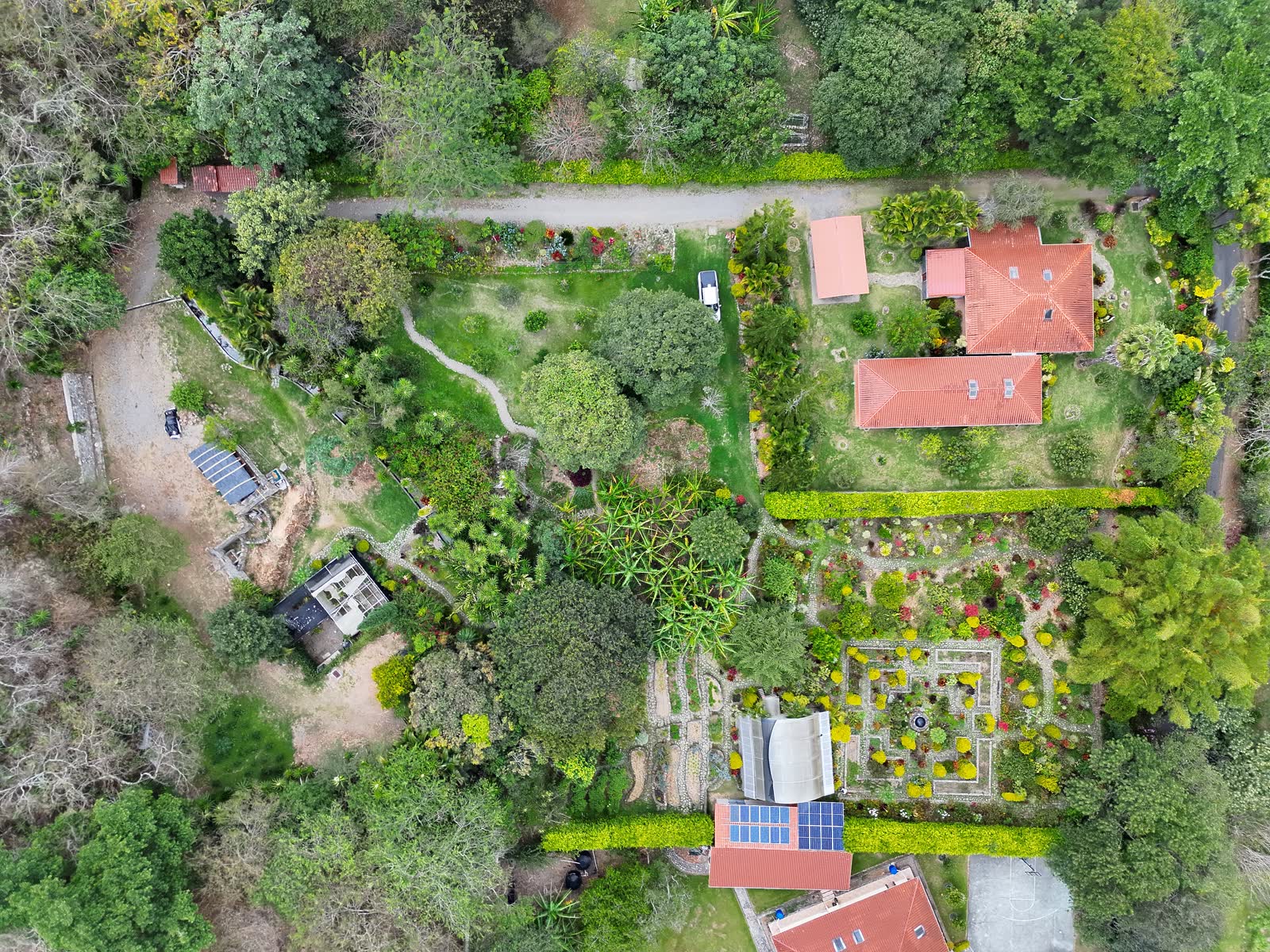
The Chakana Garden
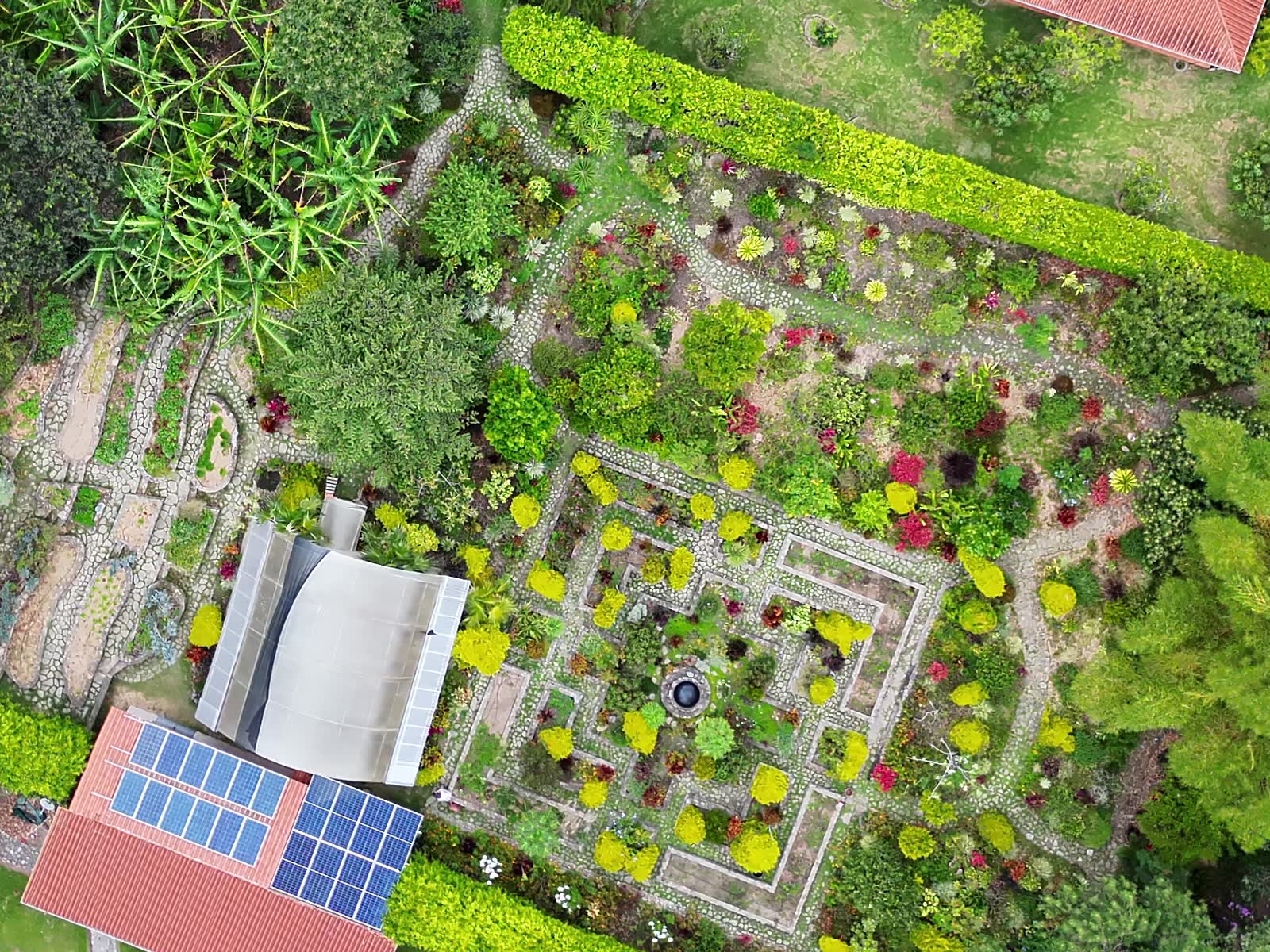
At the heart of the property is a garden unlike any other we have experienced anywhere in our travels.
Its raised stone beds form a giant Chakana—the stepped Andean Cross revered by the Inca—surrounding a circular opening that descends deep into the underground water table. Beneath that opening lies the private well that supplies virtually all of the water used throughout the estate.
My relationship with the Chakana began worlds away.
I first encountered the symbol in Cusco, Peru, the sacred capital and political heart of the Inca Empire. Vendors in the main square sold small stone Chakanas hanging from simple black cords.
The Chakana is the sacred symbol, central to Incan beliefs that held the keys to unraveling the mysteries of the cosmos.
At the time, I knew virtually nothing about Andean cosmology or the history of the symbol. I simply knew that something about it spoke to me.
I bought one, put it around my neck, and have continued to wear it almost every day of my life ever since—not because of its mystical meaning, but simply because part of me resonated deeply with it.
Years later, without any conscious intention on my part to make it the symbol of our property, the Chakana appeared again.
It was the Australian botanical expert who, without consulting me, added the first Chakana motif as the entrance to the property.
Then another botanical angel arrived. She was the owner of a large nursery in Mexico and was deeply connected to Pachamama—the universal life force of nature, time, and space, sustaining all life in the cosmos—so she had little difficulty understanding exactly what the land wanted.
This was fortunate, because my horticultural credentials were rather limited. Growing up in Manhattan, the garden I knew best was Madison Square Garden—home of the Rangers, the Knicks, and, most memorably for me, the Ringling Brothers and Barnum & Bailey Circus.
She designed the Chakana Garden and the pathways surrounding it. And then something happened that none of us had planned.
The center of her design fell on precisely the spot the dowser had previously selected for our well.
That circular opening remains there today, surrounded by the symmetrical, stepped geometry of the garden. Far below, water rises from beneath the mountain and begins a journey that eventually carries it into our home, through our orchards, and out among the flowers and vegetables growing across the property.
You can read more elsewhere on this website about the ancient meaning of the Chakana and about our water system. But there is another part of this garden's story that cannot be explained by plumbing.
During our travels through Machu Picchu, Tiwanaku, and Lake Titicaca, Arianne and I spent time with local shamans, participated in ceremonies and formed friendships that continue to this day. One of those friends, a Bolivian soul-sister, eventually built a Chakana-shaped home overlooking the Gate of the Moon at Tiwanaku.
Its four outer rooms, built around a central area, extend toward the cardinal directions. At its center, beneath a glass dome, a series of wooden tiers descends into the bare ground.
During a meditation there, I had one of the most profound experiences of my life—an experience I can only describe as being transported into the Central Sun of our galaxy. There was no sense of time and no thought. I remember virtually nothing of what occurred.
I only know that the person who emerged from that meditation was not the same person who had entered it.
When our own Chakana Garden was completed, our friend agreed to energetically link the two places. The same shaman who identified our ley line led us in a ceremony to establish that connection.
Whenever I go there to sit on the ledge of the well, I recreate the same connection to the Central Sun I first encountered at Tiwanaku. Several visitors have reported that it was one of the most powerful meditation experiences of their lives.
The Faerie Glen
Of all our gardens, this may be the most intimate.
Before we arrived, this land was a cow pasture. Much of the property was covered in tough Chilena grass, growing in dense clumps with deep, stubborn roots that had to be dug out painstakingly. A few mature trees punctuated the fields.
One of them immediately commanded our attention. She was a magnificent old mango tree several meters up the mountainside.
We never thought of her merely as a tree. She felt like the guardian of the land. And if we were going to become custodians of this place, we felt that we needed her permission.
Trees have always had a presence for me unlike almost anything else in nature. I often call them my favorite people. Over the years I have formed relationships with a handful of extraordinary trees in different parts of the world, and this mango quickly joined them.
Arianne and I sat quietly beneath her for hours over two days.
Eventually, what came to us was a concern: the previous owners had begun constructing a foundation immediately uphill from her. Had the proposed building been completed, it would have blocked much of her sun.
We made a promise that there would be no house there. Instead, we would create a garden around her worthy of her stature—much like providing a valuable painting with the perfect frame.
Here we had the assistance of our third botanical angel, a young man from Belgium who had a degree in agricultural design. We constructed stone terraces up the hillside, filled them with lush subtropical plants, and built a small stream that can be turned on at will. Water tumbles over the stones and disappears beneath the foliage. Sunlight filters through the mango's canopy, flickering across the leaves and moving water. Two stone benches invite you to sit beneath the branches, listen to the water, and do absolutely nothing other than allow yourself to merge into complete serenity.
Something happens there that is wondrously easy to experience but nearly impossible to describe. The outside world seems to recede.
Visitors frequently become quiet without anyone asking them to. Some have told us that they experienced a depth of peace they had not felt in years, as if the outside world had somehow drifted away.
Others have described sensing delicate, almost ethereal presences darting around the trees and foliage. Enough people independently described these impressions that eventually the garden acquired its name: The Faerie Glen.
You don't have to believe in faeries to enjoy it. Just sit on one of the stone benches for a while, open your heart and perhaps you might sense them speaking to you.
The Garden Out of Time
A short walk uphill from the Faerie Glen is a very different kind of retreat.
A winding stairway climbs through flowers and foliage until it reaches a single wrought-iron bench beneath the spreading branches of a thorny native faique tree.
From there, the land falls away and the mountains open across the valley.
Sit down. Look across the valley. Talk with someone you love, read, meditate—or simply watch clouds drift across the mountains while sunlight and shadow slowly reshape them.
Again and again, something curious happens. People lose track of time.
A conversation that seems to have lasted twenty minutes has somehow consumed two hours. Afternoon light turns golden. Shadows lengthen. Occasionally we have looked up to discover that the sun has disappeared while nobody noticed.
And so it became the Garden Out of Time.
We sometimes joke that the entire property is an energetic Disneyland. Instead of rides, each garden offers a different, deeply moving experience.
This one offers something quite unique—a chance to be in the presence of the sacred mountain spirits, called the Apukuna in Quechua. They are the timeless guardians of the infinite. Meeting them while sitting on a bench under the shade of a sprawling faique tree, as clouds and birds traverse the sky and the setting sun sends shadows climbing up the steep mountainsides, is so transformative that words somehow can never quite convey the fullness of the experience.
The Vegetable Garden
Not everything here is mystical. Some of it is simply delicious.
As part of her grand vision, our Mexican botanical angel envisioned a productive, organic garden that would climb naturally with the slope rather than fight it. Following her plan, we built a series of stepped raised beds whose overall shape resembles an angel spreading multiple wings across the mountainside.
This is where a considerable portion of our everyday food begins.
Blue-green Toscana kale rises beside peppery arugula. Several varieties of lettuce fill the beds with different shades and textures. There is basil to make fresh pesto sauce, carrots waiting beneath the soil, eggplant, radishes, red peppers, garlic grass, and whatever else happens to tempt us that season. Two rows of thimbleberries and several more fruit-bearing plants grow just uphill.
These vegetable beds are connected to our automated irrigation network, so each receives structured water according to its particular needs.
There is a particular pleasure in deciding what we want for dinner, then walking outside and picking it moments before it reaches the table. Food doesn't get much more local than that.
The Banana and Coffee Grove
Immediately east of the vegetable garden, the landscape changes again.
Here, broad banana leaves create a high green canopy providing shade for the coffee bushes growing beneath them. Both produce throughout the year.
Loja province and the area around Vilcabamba are rated as producing some of the finest coffee in the country. There is something about the precise combination of altitude, light, and weather that makes it unique.
There is a particular pleasure in drinking a cup of coffee that includes beans grown in your own garden.
It also makes me smile when I remember how much money we once contributed to Starbucks for coffee that, to us, was nowhere near as rich, flavorful or satisfying as what now grows outside our door.
The bananas present a different problem. There are simply too many. So we placed two bird feeders on the lawn in front of the house, filled them with ripe bananas, and discovered an elegant solution: share the surplus.
Each morning an astonishing assortment of colorful—and apparently very hungry—birds arrives to help. It’s absolutely true: when you live in harmony with nature, nature lives in harmony with you.
The Fruit Forest
This part of the property taught us patience.
The ground immediately north of the main residence was important to us, and we knew what we wanted it eventually to become. But the soil had other ideas.
Years of compaction by grazing herds of cattle had left it particularly hard and depleted. So we had no choice but to begin again from the ground up.
One of our closest friends happened to be an author and internationally recognized authority on biodynamic farming. Following his guidance, we brought in a team of oxen, whom we affectionately named Claude and Maude.
They pulled a simple wooden hand plow through the compacted earth, opening soil that had not seen the light of day for decades.
For four years, we worked that tired soil. We planted alfalfa to help restore nitrogen, brought in truckloads of organic manure, turned the soil, fed it, and planted it again. Then we waited.
Only when the soil was ready did we begin planting the fruit forest we envisioned. Today it is difficult to imagine that this vibrant and productive place was once a tired, dormant field.
Two magnificent guayaba trees dominate the garden, their branches filled with bird nests and, in season, thousands of fruits. For days at a time, hundreds of ripe guayabas fall to the ground beneath them—far more than we could ever eat—so we gather the fruit, share some with friends, and feed the rest to our worms, returning it to enrich the soil. Around them grow cherimoya, lemon, grapefruit, grafted pomelo, grapes, pitahaya, and cacao. Turmeric and ginger spread out to the west, and a third rose garden provides a constant source of cut flowers for our house.
This is not a formal orchard. It is a place where humans graze—where you reach into a tree, twist off whatever is ripe, and eat it on the spot, sometimes with the juice still running down your fingers. It is an intimacy with food that feels worlds away from strolling down the produce aisle at Whole Foods or Trader Joe’s.
When friends visit, we often wander through it together, stopping to pick and taste whatever happens to be ripe. It has become one of the most popular stops on what we jokingly call our tasting tour.
And perhaps that is the best way to understand all seven gardens. They were never created simply to be looked at.
They are places to wander through, sit within, smell, touch, taste, listen to—and occasionally lose yourself in.
Over fourteen years, what began as a mountainside covered largely in stubborn grass became something we could never have fully planned at the beginning.
We didn't impose one grand design upon the land. We listened, experimented, planted, removed, replanted, waited—and allowed each part of the property to tell us what it wanted to become.
The result is not simply a garden surrounding a house. It is the world in which our home lives.